
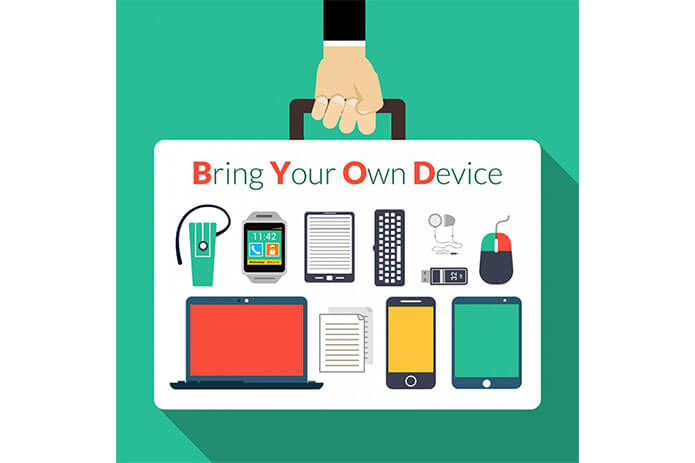
The Bring-Your-Own-Device (BYOD) trend fundamentally altered enterprise architecture. What initially began as employees connecting personal smartphones to the corporate Wi-Fi has rapidly expanded into a decentralized web of non-IT-delivered technology.
Today, the consumerization of IT includes unauthorized devices, external SaaS applications, personal cloud storage, and unvetted generative AI tools. What began as BYOD has evolved into a “BYO Everything” era, more accurately defined by modern IT leaders as massive, decentralized Shadow IT and BYOD sprawl.
The Blurring Lines of the Hybrid Workplace
The implications of the “BYO Everything” trend are far-reaching. The consumerization of IT has completely dissolved the perimeter between the corporate network and the home environment. The technology, data, and user experiences are now fully intertwined.
Modern hybrid employees select their own IT components from the open market based on their personal workflows and subjective preferences. Company data and personal data frequently intermingle on the same hardware. While end-users perceive this freedom as a massive productivity boost, it creates a terrifying operational reality for the enterprise.
The Nightmare for Enterprise IT
For CIOs and Systems Engineers, “BYO Everything” shatters traditional network governance.
While IT departments may save hardware costs by shedding company-paid cellular phones, the corporate mandate to enforce Zero-Trust security, regulatory compliance, and FinOps cost management becomes exponentially more difficult.
If an employee accesses corporate data on a personal laptop, how does IT guarantee that device is secure? Modern IT teams attempt to regain control using platforms like Microsoft Intune for Mobile Device Management (MDM) and Microsoft Entra ID for conditional access. They deploy Endpoint Detection and Response (EDR) agents like Trend Micro to isolate threats.
However, these security controls share a fatal flaw: they only work if the device is known to IT and successfully enrolled.
The Shadow IT Visibility Gap
To make informed decisions regarding security, support contracts, and compliance assurance, IT leaders require a perfectly accurate picture of the technology interacting with their network.
The “BYO Everything” era creates a continuously shifting landscape where the definition of company-controlled versus personal technology is almost completely obscured. Legacy network discovery applications simply do not have the capabilities to identify unmanaged external SaaS apps or isolate unregistered personal devices bouncing on and off the corporate VPN.
Addressing this diversity challenge requires IT departments to adopt a multi-source intelligence strategy. Relying on a single network scanner is no longer viable. IT must combine telemetry from traditional ITSM platforms, MDM consoles, identity providers, and network scanners to develop a composite picture of the hybrid landscape.
Automating the Composite Picture
The true challenge of Shadow IT and BYOD is not just discovering the rogue assets it is reconciling the massive data collisions they create. Gaps, redundancies, conflicting IP assignments, and real-time environment changes must all be resolved instantly to create a trustworthy Configuration Management Database (CMDB) baseline.
Blazent is the industry leader in Data Intelligence and automated reconciliation. Our platform seamlessly ingests diverse datasets cross-referencing your network traffic against your Intune and Entra ID registries to instantly highlight the unmanaged, “ghost” devices hiding in your environment.
By automating the resolution of your IT operational data, Blazent provides the infallible visibility required to secure the perimeter and finally master the “BYO Everything” era.
Discover the Blazent Data Intelligence Platform